Assessment Strategy Toolkit
From blank page paralysis to confident assessment strategy design
You know the assessment strategy matters.
You know it needs to stand up to regulatory scrutiny.
You know it needs to actually work in practice.
But somewhere amongst all the late-night worrying over regulations and guidance documents, your brain quietly exits the building and leaves you staring at a blank word document.
There is no getting away from it - assessment strategy development is a huge piece of work.
Your team needs to understand the regulatory requirements and guidance documents, make the right design decisions, manage the risks, document the rationale and produce a strategy that stands up to scrutiny and works in practice.
And all of that usually has to happen alongside the work your team is already doing.
Not instead of it.
The Assessment Strategy Toolkit has been built to help you break that work down into manageable chunks, so you can move forward with structure, confidence and support.
It will not write the strategy for you.
It will not take away the important thinking your organisation needs to do.
And it will not pretend that a complex regulatory document can be produced properly in 20 minutes.
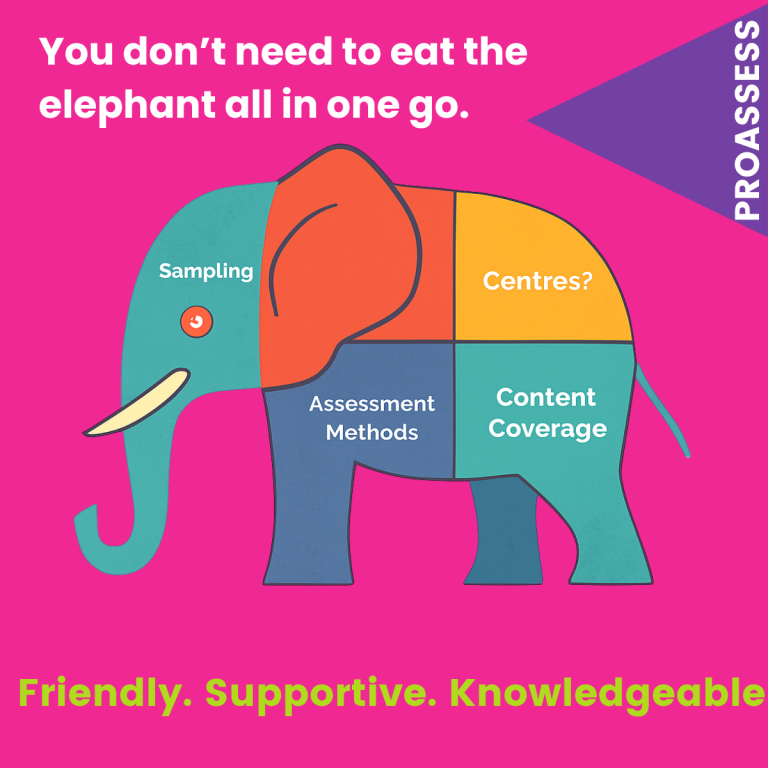
What it will do is help you work through the decisions that sit underneath a strong assessment strategy, one stage at a time, so your team can save time, reduce overwhelm and avoid having to tackle the whole elephant in one sitting.
You keep ownership of the decisions and the strategy itself, while having experienced support to help you:
- work through the complexity,
- challenge the gaps,
- sense check the approach
- turn scattered thinking into something coherent, defensible and workable.
Prompts are provided throughout to help you use AI as a supportive tool to structure your thinking and draft more confidently.
.
Why This Exists
Assessment strategy development is not just another document-writing task.
It is a substantial piece of regulatory, operational and assessment design work.
It asks already stretched teams to make decisions about:
- assessment methods,
- content coverage,
- sampling,
- synoptic assessment,
- centre delivery,
- assessment controls,
- marking,
- grading
- quality assurance,
while still keeping their existing workload moving.
That is a lot to hold.
The risk is that teams either delay because the work feels too big, or rush straight into drafting before the underpinning decisions are clear enough.
Neither is ideal.
If the thinking is not done properly at the start, the problems usually appear later: gaps in rationale, contradictions between sections, weak justification for design decisions, unclear delivery rules, or assessment models that are difficult to explain, maintain or defend.
The toolkit helps slow the chaos down and speed up progress.
It gives your team a structured way to work through the key decisions, capture the rationale, test the approach and build confidence before the strategy is drafted.
So instead of trying to eat the elephant in one go, you can deal with the work in manageable chunks, with clear prompts and expert support to help you know you are thinking about the right things.
What the Toolkit Helps You Do
The toolkit guides you through the thinking that sits underneath a strong assessment strategy, including:
- assessment design and development approaches
- assessment method decisions
- content coverage and sampling
- assessment controls and conditions
- synoptic assessment
- centre-led assessment
- grading and awarding
- fit-for-purpose testing
- mapping against Ofqual expectations
But importantly, it does not just hand you answers.
Because your organisation’s approach needs to work for:
- your standards
- your learners
- your Centres
- your delivery model
- your operational reality
What the toolkit does is help you ask the right questions, work through the implications, and make decisions with more confidence and clarity.
What’s Included
The Assessment Strategy Toolkit is a practical, structured toolkit designed to help you move from overwhelmed and second-guessing every decision to building a clear, coherent and defensible assessment strategy with confidence.
1. Assessment Strategy Starter Kit
The Starter Kit helps you work through the foundational thinking that underpins an assessment strategy.
Rather than trying to tackle everything at once, it breaks the process into manageable stages so you can build a joined-up approach over time.
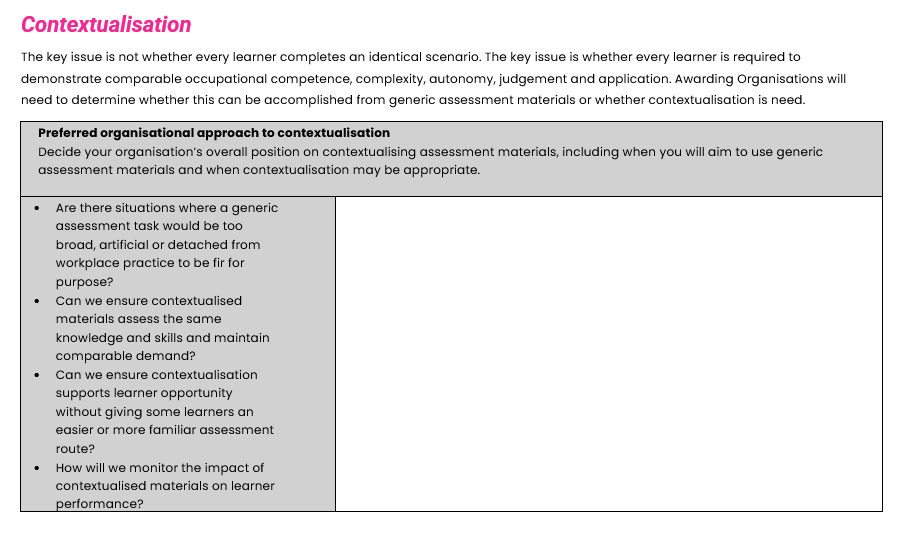
The kit is made up of a set of decision frameworks to help you work through the key choices that need to be made before writing your assessment strategy.
Each framework gives you structured prompts to help you:
- decide your approach,
- test your thinking
- capture the rationale behind your decisions
so your strategy is built on clear, defensible foundations.
- Assessment Control and Conditions Decisions - decide how assessment controls and conditions will be determined for each assessment method
- Assessment Method Decisions - Review which assessment methods are appropriate, where they work well, and what needs to be controlled.
- Assessor Requirements – Decide what your organisation requires from assessors and the support you will provide for them.
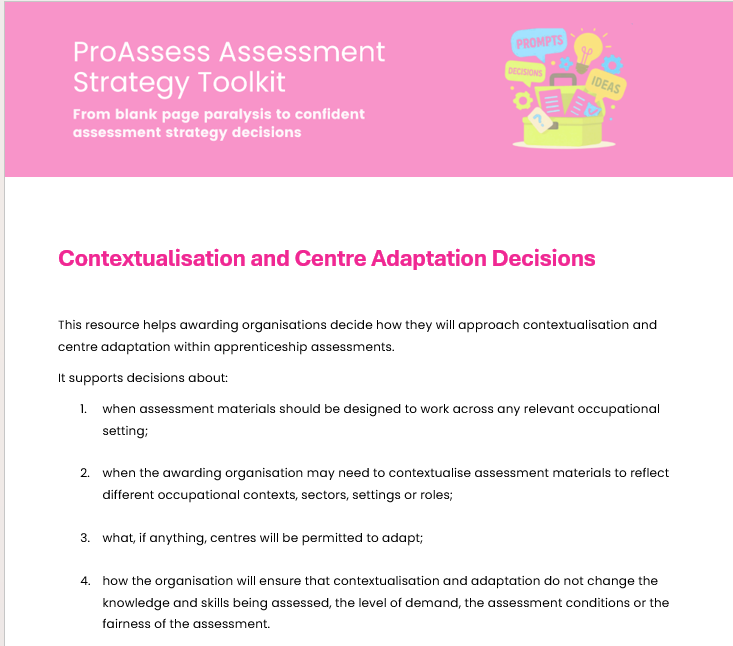
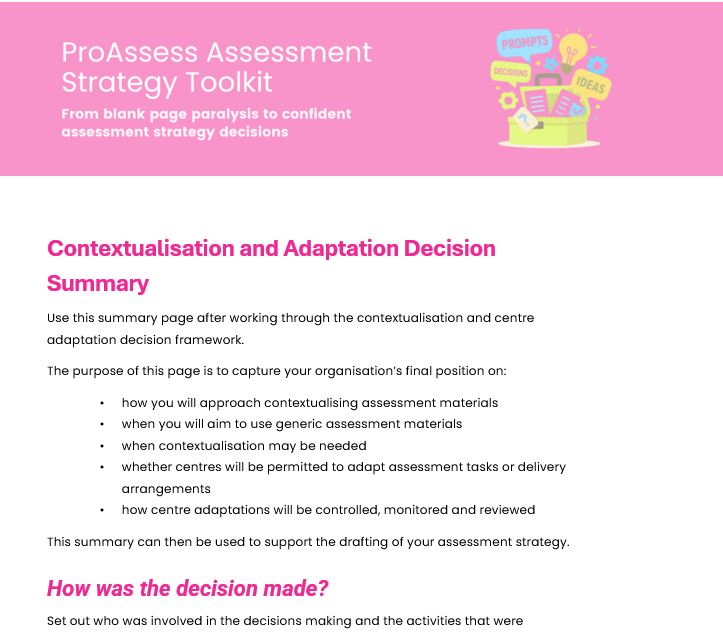
- Contextualisation and Centre Adaptation Decisions - Decide how assessment materials will work across different settings, and what flexibility centres may be given.
- Grading Model Decisions - Decide how learner performance will be marked, judged, combined and awarded.
- Integrated Assessment Decisions - Consider how knowledge and skills will be brought together within assessment, through both holistic and synoptic assessment, and how evidence will be judged.
- Resit and Retake Decisions - Decide how repeat assessment opportunities will operate fairly and consistently.
- Sampling Decisions - Decide whether your organisation will adopt full content coverage or permit sampling where this can be justified.
2. Building Your Assessment Strategy
Once your organisational approach is clearer, the second part of the toolkit helps you turn those decisions into a coherent assessment strategy.
This includes guidance and prompts to help you:
- explain and justify decisions
- demonstrate rationale
- strengthen coherence across sections
- avoid contradictions
- align decisions back to fit-for-purpose principles
- structure the strategy in a way that makes sense for your organisation
Including support around mapping to Ofqual’s expected strategy content areas without forcing you into rigid headings that do not reflect how your organisation actually operates.
Investment
The toolkit is available for just £250
Optional Extras
Kickstarter Session
A focused 90-minute session to help you:
- get unstuck
- sense check your thinking
- answer key questions
- build momentum
Perfect if you want somebody experienced alongside you whilst tackling the early-stage decisions.
£90
Strategy Reviews
Two half-day review sessions providing ongoing expert guidance as you refine and build your strategy.
This is ideal if you want:
- expert challenge and support
- another pair of experienced eyes
- reassurance that the approach holds together
- help spotting gaps, contradictions or weak rationale before they become bigger issues later
£500
Toolkit Overview
Click on the video for a short overview of the toolkit and how to use it.
Frequently Asked Questions
Can AI not just write our assessment strategy for us?
You can absolutely use AI to help you populate and shape your assessment strategy once your decisions are clear.
But AI cannot make the design decisions for your organisation.
It may be able to suggest possible rationales, risks or mitigations, but it cannot decide which approach your organisation should take on areas such as sampling, contextualisation, centre delivery, assessment methods, grading, controls or quality assurance.
Those decisions need to be made by your organisation, based on:
- your standards
- your learners
- your Centres
- your delivery model
- your operational reality
AI may help you turn that thinking into draft wording, but it cannot replace the thinking itself.
The toolkit helps you do the thinking first, so any drafting that follows is built on something solid.
Why not provide a strategy template?
An assessment strategy should be a genuine working document, not just a regulatory compliance document that is written once and filed away. It should form the blueprint for all your work on apprenticeship assessments and be a document that team refers to frequently. It therefore needs to be structured in a way that supports your team, reflects your design and development process, and helps you manage, review and improve your apprenticeship assessments over time.
Of course, the strategy still has to meet regulatory compliance and cover all the criteria in those 9 Ofqual sections. And part 2 of the toolkit helps you do that. But the aim is not to squeeze every awarding organisation into the same template. It is to help you build a strategy that is coherent, compliant, defensible and useful.
How much time and money will this save us?
We are not going to guarantee that the toolkit will save you a set number of hours.
Nobody can know exactly how long your team would take to make these decisions without the toolkit, or how long your team will need to spend on each decision framework.
What we can say is that the toolkit gives you a clear, structured and manageable way through the work.
Assessment strategy development can quickly become overwhelming because there are so many decisions to make, justify and connect. Without a structure, teams can spend a lot of time working out where to start, what needs to be considered, what needs to be evidenced and how everything fits together.
The toolkit helps your team focus on one decision area at a time, capture the rationale as you go, identify risks and trade-offs, and build confidence that you are thinking about the right things before you start drafting.
No looking at the Ofqual guidance and wondering where to start.
No repeatedly coming back to decisions because you realised you hadn't though about something
Saving your stretched team time and the organisation money.
Is it worth the price?
If your team is developing or reviewing an apprenticeship assessment strategy, £250 gives you a practical structure for a complex piece of work.
It is significantly cheaper than bringing in consultancy support to work through every decision with you, but still gives you a clear and guided approach to help your team make progress.
It is designed to help you save time, reduce internal pressure, avoid unnecessary rework and build confidence in the decisions that sit underneath your strategy.
Why not just get a consultant to write our strategy for us?
You could.
A consultant could write an assessment strategy and hand it back to you. But that does not remove your responsibility for the document.
Your organisation still needs to fully understand the strategy, own the decisions within it, and be confident that your actual practice aligns with what the document says.
That matters because an assessment strategy should not just be a polished document that exists for regulatory purposes. It should be a working document that reflects how your organisation designs, develops, delivers, awards, monitors and reviews apprenticeship assessments.
If Ofqual asks questions about the approach, your team needs to be able to explain the decisions, the rationale, the risks, the mitigations and how the strategy is used in practice.
That is harder to do if the document has been written for you, rather than built with you.
Of course, working with a consultant can still be valuable.
A consultant can provide check and challenge, guide your team through the decisions, help test your rationale and support you in shaping the final strategy. For some organisations, that additional level of support is exactly what is needed.
But where you do not need that level of support, or where the budget does not allow for it, the toolkit gives you a practical alternative.
It helps your team work through the decisions yourselves, with structure, prompts and guidance, so you can build an assessment strategy you understand, own and can confidently use.
Get in touch
Email us directly at info@proassess.org or use the webform on the 'get in touch' page.